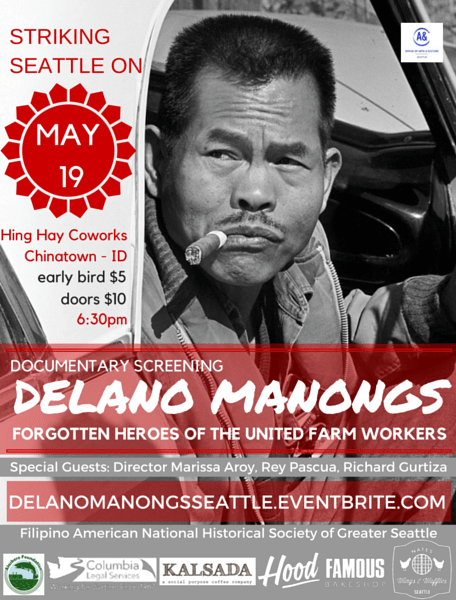
On 05/19 the Filipino American National Historical Society of Greater Seattle will be screening the “DELANO MANONGS: Forgotten Heroes of the United Farm Workers“. This Emmy nominated documentary reveals the involvement of Filipinos in the Civil Rights era of 1965 who sparked the biggest labor movement in American history and partnered with Cesar Chavez. This amazing film will bring attention to both Asian Pacific Islander Heritage Month & Labor History month in May.
Delano Manongs – Seattle Screening
Thursday, May 19 at 6:30 PM – 9:30 PM
Hing Hay Coworks
409 Maynard Ave S, Seattle, Washington 98104
Early Bird $5 – unavailable
At Doors $10 – waitlist to be called at doors, no additional guest availability.
Our screening will bring together Asian American film-makers, Asian American historians, and Larry Itliong’s personal friends to discuss and relate their experiences to the larger community. Delano Manongs Director Marissa Aroy will be present to share her vision on the creative process of filming. Never before heard commentary will come from activist Rey Pascua who travelled to Delano in his youth to work with Filipino Labor leaders. Richard Gurtiza will also be on our panel to illuminate the Seattle relationships with Filipino American labor.
The event will take place at the Hing Hay Coworks, a new community and entrepreneurial space from SCIDPDA located in the heart of Chinatown-International District.
Through the film screening, artist presentations, speaking panel, and community discussion we will increase awareness and collective community growth that will bring interaction across Seattle in the Asian Pacific American communities.
Please see the gallery of “LESSONS FROM OUR MAN@NGS: The Struggle for Filipino American Civil Rights Yesterday and Today” This was a joint event between FASA & FANHS held at UW’s Kelly Ethnic Cultural Center on Saturday, February 27th 2016. Thank you to those who attended.
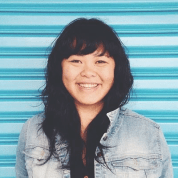
We are giving a highlight to Carmel Laurino who is the founder of the Kalsada Coffee Company. Their beans are grown in the Philippines and roasted in Seattle.
Carmel is truly an international woman, and leads a team composed primarily of women across two global hemispheres. She is also a former FANHS archive researcher who worked with Fred & Dorothy Cordova. It is because of a Filipino American historical reference that Kalsada was conceived.
1. What is Kalsada and what role do you play in it?
Kalsada Coffee Company is a social corporation working to bring to the international market Philippine coffee. We work closely with our producer partners in quality building initiatives so that they may reach specialty quality standards. As the founder, I wear many hats, currently I live in the Philippines and handle the operations and manage the Philippine based team.
2. How is Filipino coffee distinct from other varieties? What are your beans?
The coffees we’re sourcing from the Philippines are different varietals of arabica coffee from upland communities of the Cordillera region. Since we’re in the Asia Pacific Region, most would assume the flavor profiles would be similar to Indonesian or Vietnamese coffees but the Philippines has surprised us! We’re finding flavor notes that are normally associated with African coffees – floral and citrusy, but also nutty and chocolate-y notes that you would find in South American coffee. We continue to strive and work closely on the farm level to uncover other flavor notes and continue to define and redefine the Philippine coffee profile.
3. What was your experience at FANHS and how did it shape you?
I remember spending some time as an undergraduate at the University of Washington visiting and doing archival research at FANHS. I enjoyed listening to the stories of Auntie Dorothy and Uncle Fred. Their passion for storytelling and documenting the Filipino American experiences was inspiring and is part of my journey in starting Kalsada. I was doing research on the presence of Filipinos in the Pacific Northwest at the turn of the century, the pensionados and part of that research was at FANHS.
4. What is the historical significance of Filipino coffee?
The Philippines was once one of the major coffee exporters in the 1800s and was once sold in Pike Place Market before Starbucks even set up shop. There’s a distinct photo of the Filipino Coffee Company taken in 1909 that inspired my journey and was the initial spark in my curiosity in exploring what happened to this industry and what it would take to bring it back to Seattle.
5. How is your enterprise influencing the Filipino and American business circles?
We began exporting and roasting our product late last year and we’re slowly gaining traction in the US and our initial supporters have been Filipino American business owners. I believe there is a desire to support brands that connect back to our shared heritage and build meaningful and sustainable impact in our global community. This connection through great tasting coffee (perhaps I’m biased) seemed only natural and we hope to continue to build our relationships with local and national businesses so that we may be able to support more coffee growers in the Philippines.
For more amazing stories on the experience of Kalsada’s social enterprise please visit their page. https://kalsada.com/stories/
Bob Santos, Pio DeCano, Dorothy Cordova – “Lessons From Our Man@ngs”
Learn about events on Civil Rights activism from the 1960’s and 1970’s on the sectors of: Housing, Education, Employment, Human Services, Politics, and International Solidarity.
Seattle Landmark Presenters include Dorothy Cordova, Bob Santos, Frank Irigon, Pete Jamero, Dr. Pio DeCano, Dr. A. Barretto Ogilvie, Lois Fleming, Marya Castillano Bergrstrom, and more.
Break-Out Sessions on issues of FilAm activists of today include areas of: Filipino & Black Lives Matter, Filipino Diaspora and Identity, International Solidarity and Climate Justice. Today’s community presenters include Third Andresen, Luzviminda Carpenter, Troy Osaki, Enrico Abedesca, Joaquin Uy and Katrina Pestrano.
Co-sponsored by the University of Washington-Filipino American Student Association and The Greater Seattle Chapter of the Filipino American National Historical Society
——————————————————————
$5 parking available at UW’s underground garage, entrance at 41st and 15th Avenue NE
For Further Information or to reserve your seat: Contact Melanie Ministerio, UW-FASA President at 206 552-4287 or Cathy Bryant, FANHS-Greater Seattle Chapter at 206 947-3180
Attend a free seminar on Caregiving on Friday, December 4, 2015. The free forum is co-sponsored by U.S. Major General Antonio ‘Tony’ Taguba, Ambassador for AARP. If you are a caregiver, plan to be or hire a caregiver or have questions on your rights as a caregiver, this seminar is for you.
Please extend this invitation to owners of Adult Family Home Care, nurses, physicians, and your neighbors, as well as community service employees and advocates, civic leaders, and military veterans from all campaigns.
Light refreshments will be served and free booklet on ‘Care Planning Guide’ will be given to attendees.
The seminar will be held at the Filipino Community Hall of Seattle 5740 Martin Luther King, Jr. Way South Seattle, WA 98118
Date: Friday, December 4, 2015 Time: 2:00 p.m. – 4:30 p.m.
– 2:00 p.m. Reception and welcome
– 2:30 p.m. Introduction of guest speakers and presenters
– Cathy MacCaul – AARP WA State Advocacy Director
– Cheryl ReedAARP WA State Outreach Director
– Major General Antonio ‘Tony’ Taguba – AARP Ambassador
– Brigadier General Oscar Hilman – Filipino Veteran Congressional Gold Medal Director for WA
– 2:45 p.m. Major General Tony Taguba on ‘Caregiving in our community’
– 3:30 p.m. Q & A
A significant member of our population are baby boomers and are in roles of caregiving to their elder parents or relative. We are often called the ‘Sandwich Generation’ juggling our lives with work, raising a family and caring for our aging loved ones. By 2030, one out of five Washingtonians will be age 65 plus. Are you prepared to make this shift? Or are you already there and still wondering how you will be cared for in your 90’s? Find out how you can take an active role in planning for a comfortable and secure safety net for yourself and your loved ones.
The National Care Act will be covered. AARP Washington’s Ms. MacCaul will share the 2016 State Legislative Session Priorities, which will affect one out of five Washingtonians as we approach retirement age.
This seminar will be presented by our very own Major General Antonio ‘Tony’ Taguba (Retired). As an AARP Ambassador, Tony will address issues and adversities facing cultural perspectives on caregiving. Caregiving has taken national attention since 2014 due to high cost of health care, employment/unemployment, family crisis, and nonstandard program in caring for disabled loved ones. AARP is the nation’s leading advocate on caregiving; and insurance and caregiving industry has taken advantage of exploiting this issue.
General Taguba is Chair of the National FilVets Recognition and Education Project. He will also cover an update to the Congressional Gold Medal and Recognition Project, which benefits thousands of Filipino WWII Veterans and their families. As an added bonus, Brigadier General Oscar Hilman will also be present to answer any questions from families needing help with filing VA authentication documents so they can qualify for their Veterans’ Congressional Gold Medal Recognition
On Veterans’ Day, we remember, honor, and thank all the veterans for their service and sacrifice. This year, FANHS Executive Director Dorothy Cordova, FANHS member John Ragudos (Vietnam War veteran), and the FANHS Greater Seattle Chapter initiated the FANHS Filipino American Vietnam Veterans Oral History Project to record and preserve the stories of Filipino Americans who served during the Vietnam War. This video is a 7-minute introduction to the many hours of video-recorded interviews that will be part of the FANHS archive. Thank you to the Filipino American Vietnam veterans for sharing your remarkable experiences — we have much to learn from you.
Here is a preview of new oral histories being recorded at the FANHS National Archives in Seattle. Please connect with us if you are a Vietnam Veteran or know Veterans who would be interested in our project.
“What’s it like, being Muslim in America?’ Whenever I’m asked that question, it’s usually followed by statements such as, “I didn’t know there were any here in the United States.” “I thought all Filipinos were Catholic.” So, to introduce one perspective, I thought I would use an interview format with myself.
Q. Were you born a Muslim? No, no more than anyone is born a Christian or Buddhist. I consciously chose to revert to Islam when I was still in college back in the 70’s. It was a time of change due to civil rights activism, the unrest and riots on university campuses and city streets, the controversy of the Vietnam War and inevitably, the developing social conscious and awareness of many folks; and like my peers, I was profoundly moved by it all. In particular, of all the writings and books that came out at the time, the Autobiography of Malcolm X made the most impact on me.
Q. What is revert? To revert means to “To go back to a former condition, practice, subject, or belief.” One modern school of thought believes that anyone who believes in the one God and declares this (called “shahada”- one of the five pillars of Islam) embraces Islam; the root meaning being “submission” or “surrender to the one true God.” That said, the roots of Islam shares a long history with the Jewish and Christian community going back to the teachings found in the Old Testament and the Torah and also found in the Quran. So rather than say that one has converted to Islam, I use the word “revert.” One could take this notion further by saying if all believers who submit to the one true God, are called Muslims, this would include Jews and Christians.
Q. So were you Catholic before you “reverted” to Islam? Yes, like in most Filipino families who immigrated to the United States, I was raised in a Catholic family, sent to a Catholic school for 12 years of my life and did all the Catholic things expected by the church. However, with all due respect to the high standard of education that I received with regard to preparing me for college, I had always felt conflicted and suspicious of all the unaddressed issues about the Catholic church, it’s dogmas and the role it played in colonizing indigenous peoples of the Americas, Africa and Asia. After learning about the spiritual journey of Malcolm X, it made sense to me to learn more about Islam. Then after my marriage in 1986 to my (now former) husband from Lebanon, who was Muslim, my being a Muslim became more apparent to my family and few close friends who attended our wedding presided by a Sheikh from the Idriss Mosque in Northgate.
Q. How did your family or friends take it? Because I had always displayed a little rebel streak in me even as a child, my family took it with a grain of salt because I was always a little “different.” And it helped that my older siblings had already created diversity in my family with intercultural marriages to non-Filipino spouses. The diversity of the friends that I have also speaks to their openness and acceptance of people from different backgrounds. It’s not to say that I didn’t or still don’t have moments when relatives, friends or strangers would make inappropriate remarks, whether joking or not, or say something ignorant about my being a Muslim.
Q. Have you experienced negative or anti-muslim incidents? Aside from minor inconveniences like attending family parties where a lot of pork is served – all kidding aside, I personally have not. This is probably partly due to the fact that I do not wear a hijab in public (most common head covering worn by Muslim Women). I only wear them on certain occasions and when I do, some folks who weren’t aware of my religious belief have thought I was going through cancer treatment. On a more serious note, hate crimes against Muslims (or people who appear to be from the Middle East) or their establishments such as mosques, restaurants or other types of businesses are easy targets for haters. Unfortunately, one is an easier target by how you look or if your name sounds Arabic. For example, Sikhs – because the men wear turbans similar to what Osama Bin Laden wore, have also been targeted and have experienced everything from murder, malicious mischief against their establishments, their families and other bias incidents. Christians from the Middle East are sometimes also targeted. Hate crimes against Muslims peaked right after 9/11 in 2001; the most recent being the murder of three Muslim students at Chapel Hill South Carolina. Last November, headstones and memorials at a Muslim cemetery in Washington State were vandalized and in California last fall, mosques in Santa Cruz and San Diego were vandalized and there was a shooting at a mosque in Coachella. According to the FBI data, nearly100 anti-Islam hate crimes occur each year from 2011 to 2013. Muslims may be the latest “target-du-jour”, but anti-Semitic crimes in the U.S. remain consistently high, out ranking anti-Muslim or other anti-religious crimes, not to mention the countless anti-Black hate crimes and incidents, many of which go unreported or unrecorded. The following is the Southern Poverty Law Center website which has tracked anti-Muslim hate crimes and bias incidents since 9/11 until 2013. https://www.splcenter.org/news/2011/03/29/anti-muslim-incidents-sept-11-2001
Q. Any last thoughts or remarks? On being a Filipina Muslim in the U.S., what comes to mind is a remark made by the late “Uncle” Fred Cordova in his book Filipinos: Forgotten Asian Americans about Filipinos being a minority within a minority within a minority. I am who I am and it is what it is; I may have a 4th strike against me in this society because of my religion but I don’t feel alone in being a potential target. Ignorance, the current “war on terrorism”, media bias and the fluctuating economic situations of people seem to be the main triggers for haters to behave the way they do. We need to continue to educate people about other cultures and religions, examine our own biases and monitor incidents and hate crimes to stop them before they escalate into all out riots similar to the race riots of the 70’s and most recently, the Ferguson riots in 2014.




 We are giving a highlight to Carmel Laurino who is the founder of the
 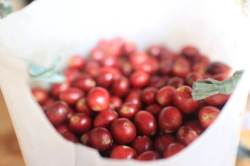 The coffees we’re sourcing from the Philippines are different varietals of arabica coffee from upland communities of the Cordillera region. Since we’re in the Asia Pacific Region, most would assume the flavor profiles would be similar to Indonesian or Vietnamese coffees but the Philippines has surprised us! We’re finding flavor notes that are normally associated with African coffees – floral and citrusy, but also nutty and chocolate-y notes that you would find in South American coffee. We continue to strive and work closely on the farm level to uncover other flavor notes and continue to define and redefine the Philippine coffee profile.
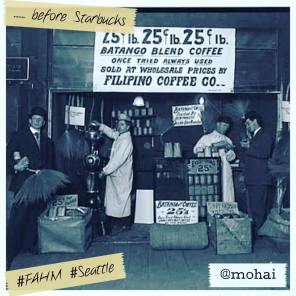 The Philippines was once one of the major coffee exporters in the 1800s and was once sold in Pike Place Market before Starbucks even set up shop.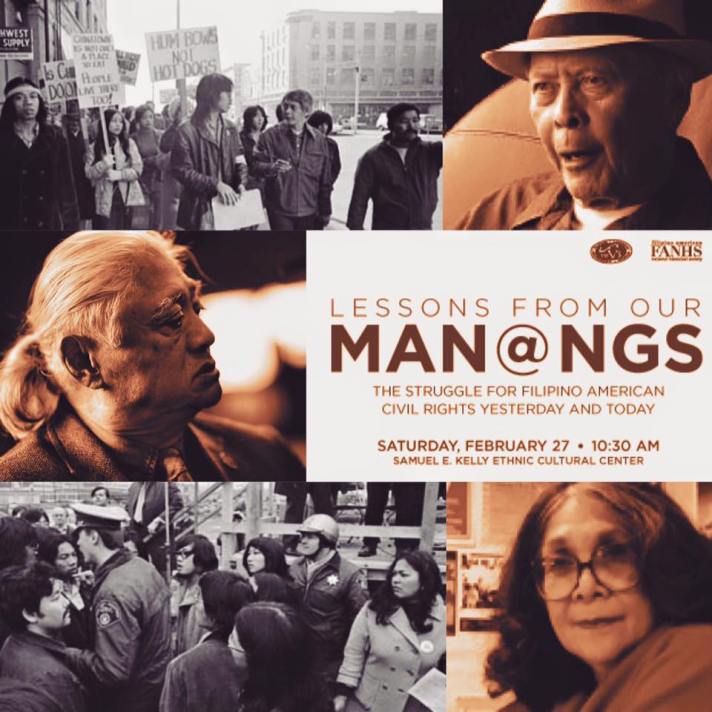


 FANHS - Greater Seattle Chapter